
Six Months of the Health Sector: Progress, Setbacks and Major Challenges Ahead
Bangladesh’s health sector has long faced a complex set of challenges, including administrative weaknesses, shortages of doctors and nurses, inadequate medical equipment, medicine shortages, management problems and concerns over transparency and accountability. Against this backdrop, the BNP-led government has approached nearly six months of its current term, with the Ministry of Health and Family Welfare facing the difficult task of addressing both immediate emergencies and longstanding structural weaknesses.
Six months is a relatively short period for transforming a vast and complicated national healthcare system. Yet even within such a limited timeframe, a government’s priorities, emergency responses and administrative approach can begin to emerge.
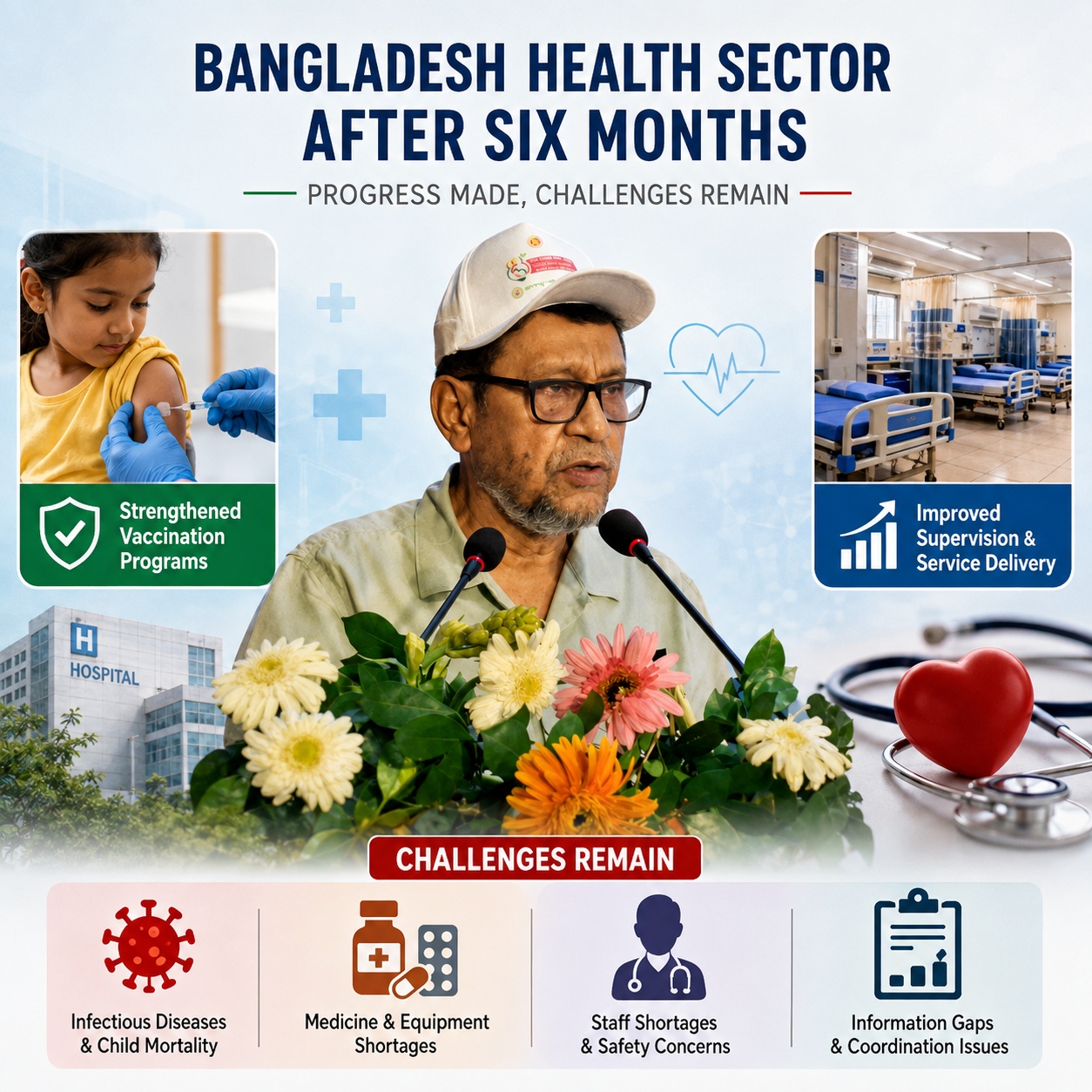
An assessment of the health sector during these first six months presents a mixed picture. On one hand, the government has taken steps to strengthen emergency vaccination programmes, increase monitoring of district and upazila-level hospitals and address the safety and working environment of healthcare professionals. On the other hand, significant challenges remain in controlling infectious diseases, addressing medicine and equipment shortages, resolving shortages of doctors and nurses, improving coordination and ensuring timely and reliable public information.
The first six months, therefore, may be viewed less as a period of complete reform and more as a period of crisis management, problem identification and preparation for longer-term transformation.
The First Major Test: Childhood Vaccination
One of the most significant challenges facing the health authorities after taking office was the need to strengthen childhood vaccination programmes.
Vaccination is among the most important preventive healthcare measures available to any country. When children fail to receive vaccines on time, or when routine immunisation programmes experience disruptions, the consequences can quickly become visible in vulnerable communities.
Diseases such as measles, diphtheria, whooping cough and polio can be prevented or controlled through effective immunisation programmes. Maintaining continuity in vaccination is therefore essential for protecting children and preventing outbreaks.
The government has taken steps to strengthen nationwide vaccination activities, including special campaigns in vulnerable and high-risk areas. These initiatives have brought a significant number of children under vaccination coverage.
This can be regarded as one of the notable positive initiatives of the first six months.
However, important questions remain.
Why did such an emergency arise in the first place? Why were some children unable to receive essential vaccines on time? And why did preventable diseases such as measles gain an opportunity to spread?
These questions cannot be attributed solely to the six months of the current administration. The situation is also connected to earlier weaknesses in management, supply chains, field-level implementation and healthcare administration.
How Sustainable Will Measles Control Be?
Controlling measles has emerged as a major test for the health authorities.
The spread of measles among children, along with reported deaths, has generated public concern and raised questions about the effectiveness of preventive healthcare systems.
Launching emergency vaccination campaigns is an important response. But the long-term solution lies in strengthening routine immunisation so that children receive their vaccines before an outbreak occurs.
The strength of a healthcare system is not measured only by how it responds to an outbreak. It is also measured by how effectively it prevents that outbreak from occurring.
For this reason, Bangladesh will need to strengthen routine vaccination coverage, improve access to immunisation in remote communities and develop better mechanisms for identifying vulnerable populations.
Efforts to Restore Momentum to a Troubled System
Administrative stagnation and management weaknesses have been among the longstanding problems of Bangladesh’s health sector.
District and upazila hospitals serve as the primary healthcare lifeline for millions of people. Yet these institutions have frequently faced complaints concerning doctor attendance, nursing shortages, inadequate equipment, medicine availability and patient management.
During the first six months, the Ministry of Health has increased monitoring of doctors’ attendance and service quality at district and upazila-level hospitals.
Greater administrative oversight is certainly a positive development. But monitoring becomes meaningful only when it produces measurable results.
How many hospitals have improved doctor attendance? How many have strengthened emergency services? How quickly are patients receiving treatment? How much have medicine shortages been reduced?
Regularly publishing such information could significantly improve public confidence in the health administration.
Healthcare Workers’ Safety: An Old Problem, a New Priority
The safety of doctors, nurses, technicians and other healthcare workers remains another longstanding concern.
Heavy patient loads, inadequate infrastructure, emergency situations and tense encounters between medical professionals and patients’ relatives can create difficult working environments.
Against this backdrop, plans to improve healthcare workers’ security and replace damaged or unusable medical equipment represent important initial steps.
But security cannot be ensured simply through the presence of law-enforcement personnel. Better hospital infrastructure, efficient patient-management systems, transparent complaint mechanisms and improved doctor-patient communication are equally important.
Healthcare professionals need an environment in which they can perform their duties safely and professionally.
Medicine Shortages Remain a Major Obstacle
For millions of Bangladeshis, government hospitals are expected to provide essential medicines either free of charge or at affordable prices.
However, shortages of medicines at public hospitals have been a longstanding problem. The effects of previous mismanagement, corruption, weaknesses in procurement and problems within supply chains have not disappeared within six months.
As a result, many patients are still required to purchase medicines from outside hospitals.
The problem does not end with medicines. Patients are also sometimes required to undergo diagnostic tests outside public hospitals because of inadequate facilities or unavailable services.
This remains one of the most visible challenges facing health-sector reform.
Medical Equipment: Why Does the Shortage Persist?
Modern healthcare requires more than simply purchasing sophisticated equipment. Medical devices must be operational, properly maintained and managed by trained professionals.
In many hospitals, diagnostic facilities remain limited. In some cases, equipment exists but is not functional. In others, machines are available but there are insufficient trained operators. Some equipment may also remain unused because of inadequate maintenance.
Breaking this cycle will require more than purchasing new machines.
The entire process—from procurement and installation to operation, maintenance and replacement—needs greater transparency and accountability.
The Doctor Shortage Outside Major Cities
One of the oldest problems in Bangladesh’s healthcare system is the disparity between urban and rural healthcare.
Major cities generally have greater access to specialist doctors and advanced medical facilities. In contrast, hospitals at the upazila and remote levels continue to struggle with shortages of doctors and nurses.
As a result, patients living in rural areas often have to travel to district headquarters or Dhaka even for conditions that could potentially be treated locally if adequate facilities were available.
True healthcare development will require ensuring that ordinary citizens can receive essential primary and emergency care close to home.
This means not only recruiting more doctors but also creating conditions that encourage them to serve and remain in rural areas.
Recruitment Alone Will Not Solve the Problem
The rural healthcare workforce shortage cannot be solved simply by appointing more doctors.
Doctors and other health professionals need adequate accommodation, security, transportation, educational opportunities for their families and opportunities for professional development if they are expected to work in remote areas for extended periods.
A long-term health strategy should therefore consider incentives and improved working conditions designed specifically to retain healthcare professionals outside major urban centres.
Questions Over Information and Coordination
Accurate information is essential during any healthcare crisis.
When an infectious disease begins spreading, people need timely and reliable information about the number of cases, deaths, affected areas, vaccination coverage and hospital preparedness.
Questions and criticism have emerged regarding the Ministry of Health’s communication and coordination during certain health crises.
Some statements by the Health Minister and aspects of the government’s crisis-management approach have also generated mixed reactions and criticism among sections of the public and civil society.
In a public health emergency, weak communication can make an already serious situation even more difficult.
The Ministry of Health therefore needs a strong, rapid and evidence-based public communication system capable of providing accurate information while preventing confusion and misinformation.
Reform Will Remain Incomplete Without Tackling Corruption
Corruption remains another major challenge for the health sector.
Allegations of irregularities have historically surrounded the procurement of medicines, medical equipment, construction projects and various administrative processes.
A hospital may receive expensive equipment costing millions of taka, but if that equipment remains unused, what is the actual value of the expenditure?
Similarly, purchasing medicines on paper provides little benefit if those medicines do not reach the patients who need them.
Transparency and accountability must therefore become central pillars of health-sector reform.
What Can—and Cannot—Be Achieved in Six Months?
It would be unrealistic to expect a government to completely transform Bangladesh’s healthcare system within six months.
Building hospitals takes time. Training doctors and specialists takes years. Introducing advanced medical technologies requires infrastructure, financing and skilled personnel. Reforming a weak procurement or supply system also requires sustained effort.
Therefore, it would be unreasonable to demand that every longstanding problem be solved within the first six months.
What can reasonably be assessed, however, is the government’s choice of priorities and the initial results of those priorities.
From this perspective, strengthening vaccination campaigns, increasing administrative monitoring and developing plans for healthcare workers’ safety are positive steps.
At the same time, infectious disease control, shortages of medicines and equipment, staffing shortages and weaknesses in information coordination remain significant challenges.
The Next Six Months Could Be Crucial
If the first six months are viewed as a period of identifying problems and responding to emergencies, the next six months should focus increasingly on implementation and measurable reform.
Several priorities deserve particular attention.
First, routine vaccination programmes must be strengthened.
Second, the presence of doctors and nurses at upazila and district hospitals must be ensured.
Third, essential medicines should be consistently available at government hospitals.
Fourth, non-functional medical equipment should be identified and repaired or replaced without unnecessary delay.
Fifth, effective measures must be introduced to protect healthcare workers.
Sixth, greater transparency should be established in health-sector procurement and supply chains.
Seventh, systems for publishing disease and mortality data should become faster, clearer and more reliable.
Preventive Healthcare Must Become a Priority
Bangladesh’s healthcare system has traditionally been heavily treatment-oriented. People often seek medical attention only after becoming sick.
The future of public health, however, must place greater emphasis on prevention.
Vaccination, nutrition, safe water, sanitation, maternal and child health, regular health screening and public awareness can all reduce the burden of disease.
The recent experience with measles has once again demonstrated how important strong preventive systems are.
A healthcare system that prevents illness is ultimately more sustainable than one that only treats patients after they become seriously ill.
Public Trust Will Be the Ultimate Measure
Perhaps the most important measure of healthcare performance is public trust.
If patients believe that they can visit a government hospital and receive appropriate treatment, essential medicines and necessary diagnostic services, confidence in the healthcare system will increase.
But if patients arrive at a hospital only to discover that medicines are unavailable, doctors are absent or essential tests must be conducted elsewhere, public confidence will inevitably decline.
Rebuilding that confidence should therefore be one of the central objectives of health-sector reform.
Conclusion
An assessment of Bangladesh’s health sector during the first six months of the BNP-led government reveals a mixed picture.
The strengthening of emergency vaccination programmes, special efforts to address measles and other preventable diseases, increased monitoring of district and upazila hospitals and initial measures concerning healthcare workers’ safety and medical equipment are among the positive developments.
At the same time, outbreaks of measles and other infectious diseases, deaths among children, shortages of medicines and medical equipment, shortages of doctors and nurses, weaknesses in rural healthcare and concerns about information and coordination remain unresolved.
A troubled healthcare system cannot be completely rebuilt within six months. The most important achievement during such an initial period should therefore be the accurate identification of problems and the creation of a credible foundation for long-term reform.
The real challenge now is to build upon that foundation.
The people of Bangladesh want a healthcare system in which they do not have to travel to the capital for basic medical treatment; where essential medicines are available in government hospitals; where doctors and nurses are adequately staffed; where healthcare workers can perform their duties safely; and, above all, where no child loses their life to a preventable disease.
Meeting these expectations will require the Ministry of Health to move beyond emergency responses and pursue long-term reforms centred on preventive healthcare, strong primary health services, skilled human resources, transparent procurement and accountable administration.
The questions raised during the first six months now require practical answers.
And ultimately, the most reliable measure of those answers will not be official statements or administrative reports—it will be the everyday healthcare experience of ordinary people across Bangladesh.